Monday, February 17, 2014

Japan: A Continuation

It has come to an end now, my two weeks of travel in Japan are over and I find myself again, sitting on my bed in Taiwan, reflecting on another week gone by.  I enjoyed every day of my vacation, and I easily could have spent several more months on the road, but I would by lying if I said it isn’t nice to be home as well.  The warmth of my own cushy bed, the knowledge of where exactly where I will be staying tonight, the ability to maneuver the roads without worrying I am lost, and most importantly, the close circle of friends I have made, make coming back to Taiwan a pleasant follow-up to an amazing trip. 
Perhaps it was time, long distances, and my backpack that weighed down on me more in my second week of travels, because I feel like I accomplished less that I would have liked.  Regardless, I have enough stories to keep me satisfied for a short while as I plan my next journey (which will be in Taiwan but is only two weeks away).
Let’s look back through this week:

Monday, February 10th
This was a first, for I don’t believe I have ever woken up in a plastic box before, but that is the nature of the capsule hotel.  I am glad I had this experience, but it wouldn’t be my number one choice of sleeping arrangements, it was less social than a hostel, more expensive than a hostel, and not weather resistant (the plastic walls kept the air a bit too cold).  Adding to the strange experience, when I woke up and was ready for a shower, I made my way to the public bathhouse.  I don’t know how many of you have used communal showers, but if you have used one you are probably picturing a college dorm, with little stalls and privacy curtains.  You are almost certainly not picturing a Japanese bathhouse, with low-mounted shower heads, plastic stools to sit on, and a large nude bath (onsen) to warm yourself in.  Well, I believe “When in Rome, do as the Romans”, so it follows that “When in Japan, do as the Japanese”, so I followed suit, stripped down, rinsed off, and climbed into the tub.  I’m not highly comfortable with nudity, I tend to reserve it for my own bedroom/bathroom, but there is something freeing about realizing that no one else cares, no one is judging, no one is even looking at you.  Clean and ready for an exciting day I, did nothing.  Seriously, I accomplished very little with my day, because I spent 10 hours of it on a train.  My travel plans included a trip to the northern city of Sapporo on the Hokkaido island of Japan, and because my JR pass covered free train travel, this was the financially responsible option (rather than flying, which is what most of the locals do between islands).  I got onto the train around noon, and arrived in Sapporo just after 10, feeling tired and a little bored.  Did you know there is very little happening in the northern Honshu of Japan, at least as far as tourists are concerned.  The only noteworthy aspect of the train ride is the use of an underground (and underwater) tunnel, which runs between the islands. 
When I finally left the train I almost immediately regretted my decision to travel so far north.  The ground was covered in feet of snow, and I slipped with almost every step I took along the icy sidewalks.  Teeth chattering, body shivering, I pulled my scarf tighter around my neck and rushed to get indoors again.  I used to be so good with cold weather, but Taiwan has spoiled me (I dread to think what it will be like for me the next time I spend winter in the Midwest).  Thankfully, a comfy bed, a microfleece blanket, and a powerful heater made that go away for the night.

Tuesday, February 11th
This is the day I have been waiting for, the only real aspect of my vacation that I planned prior to my arrival in Japan, the day I got to see the Sapporo Snow Festival.  I will admit, I did just complain about how cold the previous night had been, and I don’t know if it was my excitement, or just a warmer day, but I didn’t feel so miserable outside.  I jumped right on the subway and I went to main home of the festival: Odori Park. (other portions were at the Tsudome (I didn’t visit that) and the Susukino streets (which I walked later at night).  I am surprised to say that the venue of the festival was smaller than I expected, but maybe that was because it was across a very long, thin rectangular park rather than a square.  The first sculpture I saw was easily my favorite, carved in the ice, there was a recreation of the National Palace Museum and Taipei 101 (two landmarks of Taiwan), reminding the world of one of my favorite countries.  Among the other displays (either sculpted in ice or snow) were clock towers and castles, people and animals, even a pretty accurate car advertisement.  I am so impressed with this form of art, to be this creative, effectively execute your ideas, and be ok with the limited lifespan of the work is definitely beyond my abilities.  Another aspect of the festival was in live showcasing of winter sports skills, which was done in Odora Park on an air jump slope.  Here skiers and snowboarders could show off trick jumps in what appeared to be too small of a venue to me (but there weren’t any problems with this as far as I saw).
One of the many advertisements posted around the city for the snow festival.
The Japanese know it is"Time for Taiwan" as well, here I am at the National Palace Museum (in ice form).

Feeling like I had thoroughly experienced the park’s attractions, and knowing there was much more to do in the city, I wandered the surrounding area to find the Tokei-dai Clocktower, one of the city’s most iconic structures.  To be honest, entering the clocktower is overrated.  The majority of the displays are unrelated to your currently location, there is no view from the upper level, the signposting is uninteresting, and there are very few artifacts.
The Sapporo Clocktower.
Sapporo is home to a couple of famous beer breweries, the main ones being Sapporo and Asahi, so I jumped on the bus and made my way to the Sapporo Beer Garden and Museum.  I know, a lot of people don’t picture me as a beer drinker, that is because you knew me prior to my introduction to Asian beers, which seem to go over much better for me.  Drinking Sapporo beer in Sapporo seemed like a unique experience, and it certainly was, but not as unique as the museum displays explaining how beer is made.  I made friends with other travelers courtesy of these displays which started by depicting a Willy-Wonka-like factory in which mouse like workers collect the grain while a human figure supervises their work from a beanstalk in a cloud and progressed to showing that same human figure drunk in an oversized mug of beer, floating on a pool of beer (yes, it was really that weird).  We drank a few Sapporo beers, found some dinner in the nearby mall, then saved a bit of money by walking back to the city center instead of catching a taxi.
The only beer museum in Japan, located in Sapporo..
Beer, the best ingredient for making friends.
Wednesday, February 12th
Ahh! What an annoying morning.  It is the hazard of being in a hostel that other people can wake you up, but this morning got me out of bed an hour before plan.  One of the other backpackers slept through her alarm clock for about ten minutes which cleared everyone else out of the room.  Today is the day I leave Sapporo, but I have an important decision to make: should I catch an early train and spend my evening in Tokyo, or catch a late train and spend my day in Sapporo.  Sapporo won in my mind, because I had heard good things about the Historical Village of Hokkaido and was excited about going to see some of the transplanted traditional houses from different periods of history in this area.  The interesting thing about Hokkaido is that it hasn’t been inhabited for very long, so the history only really stretches across the 19th and 20th centuries.  In this park they have preserved or recreated shops and houses from these centuries to display how life has changed through the years, with most structures allowing visitors to walk through their interiors (provided they remove their shoes).  Also, because of the boots and cross country skis were provided for visitors who wished to explore in this manner.  The thing that made this day-trip for me was the people I wandered with.  I met a couple of other foreigners (one who had been in the area for most of a year, had taken a guided tour of the attraction before, and was able to provide commentary on many of the artifacts.  I have a feeling I would have skipped through this attraction in under an hour and missed out on the amazing displays without their company.
The Old Sapporo Railway Station, now in the Historical Village of Hokkaido.
It started to get late, and at a certain point I know I wasn’t going to make it to Tokyo that evening, so the choices began again.  Was it a better idea to take an overnight train and try to sleep in transit, or stay in my hostel for an additional night?  I made the traveler’s choice, not necessarily the smart choice, and decided not to sacrifice anymore precious daylight hours, so I took a train starting at 10pm, bound for a 9am arrival in Tokyo, and slept, slumped-over like a rag doll (thank goodness for my age, because I know there is a time when I won’t be able to do this anymore).

Thursday, February 13th
Good morning, Tokyo!  I should have been more exhausted, but I felt ready for a day of exploration as soon as I dropped my luggage off at the night’s hostel.  The nearest site is also one of Asakusa’s (the district I was staying in) best known temples, called Senso-ji.  Those typical pictures of tourists under giant lanterns in the gateway to a temple are probably taken here, and I’ll admit, took those pictures as well.  Everyday, thousands of locals and tourists make their way to the temple to cleanse themselves with smoke from the incense burners, pay their respects to Kannon (the Buddhist goddess of mercy), and have their fortunes predicted with the fortune sticks (Kau Cim).  To find your fortune you pick up a wooden cylinder filled with small sticks (each labeled with a number), turn it upside-down, and shake it until a single stick falls out of the small opening on the top. I’m sad to state, I received a bad fortune, shaming me for not having studied, and predicting negative experiences in my life, especially travel (oh no!).  It is a nice thing to not be superstitious about things like this. 
"Holding up" one of the oversized lanterns of the Senso-ji temple.
I stayed around the temple area for quite a while, and did my first bit of souvenir shopping on the nearby streets of Nakamise-dori.  I found souvenir shopping in Japan to be difficult because so many of the trinkets I could buy were too similar to the items I have bought in Taiwan over the past year and a half (especially the fans, lanterns, and snacks).  That probably helped me save a lot of money.
Shopped-out, I went and did some people watching instead.  Did you know that Tokyo is home to the busiest intersection in the world? That doesn’t seem like much of a surprise if you have ever seen videos of the Tokyo subway station, but surprisingly it isn’t at the main station that the intersection can be found.  Instead, I need to go to Shibuya, and there, in front of the station, hundreds of people cross the streets each time the pedestrian crossings light up.  The area is so busy that all directions of traffic stop at the same time to allow walkers to pass through.  I walked and waited for a few minutes, then went to observe from the upper level of the nearby Starbucks (which is said to be the best place to people-watch from).  
I don't think all roads lead to Rome, they all lead here, to the intersections near Shibuya Station.
Wanting to see even more of the locals, I went to the fashion center of Tokyo: Harajuku.  I am not known for my fashion sense, you will never catch me leading trends, but I was pretty unimpressed with the clothes I saw on display.  Still, it was fun to see a few scattered people, dolled up in their Harajuku fashions (I have since learned that Thursdays are a bad night to stroll these streets because the people leading the fashion trends all have school the next day).

Friday, February 14th
Happy Valentine’s Day from Japan.  What I got as a present was the worst weather of my trip.  The amount of snow outside was astounding, and because the temperature was fairly close to 30 degrees (Fahrenheit), the snow was very wet.  The moment I stepped outside I was soaked.  My goal of the day was simple, I was desperate to see Mt. Fuji.  I did my research and knew that the Fuji Five Lakes area would present me with some beautiful pictures of the volcano, so I went to the bus station only to discover all of the buses had been canceled for the day.  This depressing news wasn’t going to stop me, I jumped on a Shinkansen and watched out the window for it, but the snow prevented any view.  I wasted several hours of my day on this fruitless quest, and finally had to give-up.  Most of my day was spent with similarly fruitless wanderings, finding small restaurants for meals, or street vendors for souvenirs, but that was about it. 

The Shinkansen, preparing to take my back after my unsuccessful trip to see Mt. Fuji.
Then came the evening, which made up for the day because it allowed me to accomplish one of my goals in Japan, which was to eat Fugu.  Fugu is puffer fish, a dish which, when prepared incorrectly (if the sack of poison is not removed carefully) could kill you.  One of the girls I met from a hostel in Kyoto and I went out to get dinner together and decided on this deadly delicacy (and, based on the fact that I am writing this, we survived).  We split a seven-course meal, and most dishes were made-up of this fish meat, including raw fugu-skin, fugu sashimi, fugu BBQ, and fugu hot pot.  The novelty of this experience really made it interesting, there is nothing particularly unique about the taste of the fish itself.
Getting ready for the hot pot portion of our fugu dinner.
Friday night in my hostel was the only time I disliked my decision on where to sleep during this trip.  I was blessed with some great hostels, but this was not one of them.  For starters, my bed was pressed against the window, and the cold of the outdoors chilled my entire sleeping space.  That would have been more bearable if the room’s heater ever aimed at my corner of the room.  The big problem, however, was that the snow was coming through a crack along the side of the window and landed all over my bed.  I tried to cover the crack with sheets and curtains (that were too small), curled up into a tiny ball, and miserably shivered all night long (I don’t know that I got much sleep).

Saturday, February 15th,
It is sad to think that this was my last full day on this beautiful island.  The snow had stopped, but for some reason the rains started and worked to make the ground awful with each step.  I wrapped my feet in plastic bags, wore two layers of socks, and still ended up soaked and pruney at the end of the day.  I wanted to start my morning at the Tsukiji fish market, but the weather slowed my travel and the majority of the vendors had packed up and moved on by the time I arrived.  Tsukiji fish market is a popular place for tourists to visit in the mornings, and a lucky 120 tourists each day are chosen to watch the tuna auctions in the morning, but arriving at 4:30am (long before the trains start running) meant that the travel costs wouldn’t be worth the lack of sleep I would have gotten.  I may not have gotten to enjoy the fresh fish sales, but I did enjoy the fresh fish purchases, in the form of sushi at one of the local restaurants.  It was the freshest fish I have ever had!
Before I knew it, the rain had cleared, the day was warming (and the streets were becoming slushier as the ice melted), and I renewed my goal of seeing Mt. Fuji.  This time I decided to pick a high point in the city center, so I went to Tokyo Tower, a symbol of the city which looks like a red version of the Eiffel Tower (but it is taller).  Atop the tower I could see a long ways in a full circle of directions, and I squealed when I saw the sign for “Fujisan”, but alas, the clouds obstructed the view of all but the mountain’s base.  And that is how the volcano alluded me. 
At the base of Tokyo Tower
This is the closest I got to seeing Mt. Fuji...What a disappointment.
The last big site of the day was the imperial palace, the place where the emperor still lives with his family.  I thought this would be a cool sight to have seen, especially after having visited Osaka Castle, but there is nothing to see on about 363 days of the year (visitors are allowed further than the gardens for the New Year and the emperor’s birthday).  There were a few visible guard houses, large stone walls, and a large variety of trees (all in their winter state, so many weren’t in bloom).
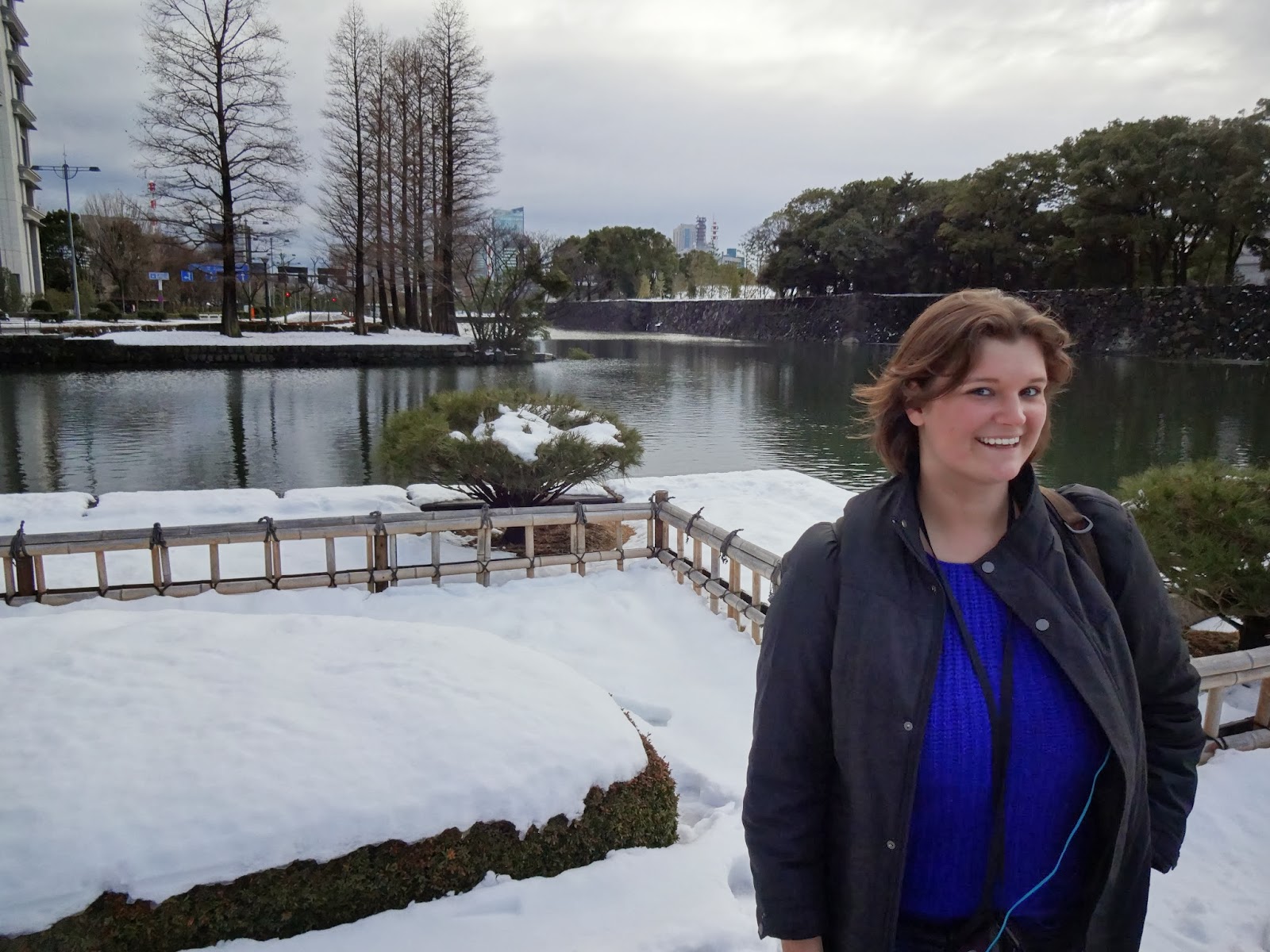
The moat surrounding the Imperial Palace.
As it was starting to reach early afternoon, I went back to Tokyo station and took the bullet train to Osaka where I went straight to the airport and spent the night on a row of chairs.  I never thought that I would be the type to sleep in an airport, but it was such a logical choice that I would gladly do it again.  This allowed me to arrive at the airport via train (all public transportation would have been closed at the needed hour, but my train pass let me travel for free), saved me money on a hostel, and ensured that I didn’t miss my 7am flight (it is no secret, I am not a morning person).   I was surprised to see quite a large number of people doing the same thing, and I was thankful for my arrival time because it gave me a prime location next to an outlet as I watched all of the other rows of chairs being converted into temporary beds.  I waited, and napped, and eventually boarded my plane and flew away.

And now, here I am again, back in Taiwan, happy to have had all of these experiences.  There is so much more that I could say about Japan, so many points I could make about cultural differences, but I am no real expert, and have my own continued research to do.   My last, and most important thought on the trip is this:

*The Japanese know what they are doing when it comes to toilets.  There is nothing better than realizing the seat is heated, not the cold ceramic you have come to expect.  Also, the water features of the high-tech toilets are appreciated once you understand how to use them.

Monday, February 10, 2014

Japan: The Long Story

I’m sorry to let you down, but I have no updates from Taiwan this week.  In fact, I haven’t even seen the country since Monday.  No, I haven’t moved, I still love Taiwan, but it was time to get out and see some more of what Asia had to offer, so I extended my Chinese New Year break for an additional two weeks and have flown to Japan.  I’ve been told it was a ‘brave’ choice to move to Taiwan, and to that I say, this vacation has required far more courage than that move did.  I spent weeks assessing and reassessing whether it made more sense to book hostels and trains in advance or play it by ear, and to the dismay (but not surprise) of those who know me, I decided to no to preplan the majority of my stay.  The things I knew before arriving on the island: I would be arriving in, and departing from Osaka, so my adventure would need to lead me in a circle; I had a limited budget, but had pre-paid the majority of my transportation expenses with the JR pass; and my former Japanese abilities were not strong enough to help me at all.  Seven days into the adventure, and things have come together, perhaps better than they should have, and I couldn’t be more delighted. Every night before I go to bed, I plan the following day’s travel and accommodation (if I am at the end of my stay in the city/hostel).
You might be thinking, “Who goes to Japan alone?”.  Well, I do, but as I have been told in the past, and experienced first hand this week, you are only alone if you choose to be, and my appreciation of social interactions has helped me find friends at every stop along the way.  The best thing about starting a simple conversation, is you never know where it will lead, what ideas it will give you, what stories you will hear, and when your conversations are with travelers, the topics are never dull.  I accept any judgment this may cause, because I know how amazing Japan is, but I think my favorite parts of the trip, so far, have been back at the hostels with the other backpackers. 
I have done so much this week that even the Reader’s Digest version of events is a novel.  Be warned now, a lot of words are about to come out of my fingertips, some exciting, some dull, but every one a vital part of the story to me.

Monday, February 3rd: The adventure begins
The original plan was to fly out of Taoyuan airport at 6:40pm, but delays soon extended my wait time by two hours.  In general, that wouldn’t bother me, I am a night person, with no set plans for the day except to arrive in Osaka and check into my hostel, unfortunately, the late arrival time meant the majority of public transportation options were closed for the evening.  The information booth directed me to the last city bus of the evening, and as I patiently waited, I slowly realized how little I knew about my plans.  Thankfully (and surprisingly), I was standing next to a tri-lingual Taiwanese man who worked in Japan (and it has only taken me a week to remind myself that I had just gotten off of a flight which probably contained several people of similar backgrounds and skill sets).  He helped me pick my bus stops, then later helped me direct a taxi to my hostel, where I passed out from exhaustion almost immediately.

Tuesday, February 4th: A tour of Osaka
I woke up on Tuesday, freezing (because I hadn’t unfolded my comforter correctly), and realized it was time to start my day.  I’ll be honest, I didn’t have big plans in Osaka, and looking back on it, it has been my least favorite city in this trip.  It is a fairly typical city, lacking what I thought would immediately stand out as “Japanese culture”, but perhaps that is because I have had a year and a half to experience Asian culture and was just expecting, but not finding, something significantly different from Taiwan.  I consulted my guidebook and decided that my main goal was to find Osaka castle, so I set off on a walk.  Walking has been a vital, yet painful part of my travels, because even now, I can still feel the results of my beachside fall on Green Island, which causes a strong pain in my knee, especially while walking down staircases, and has led to tension in my shins from the modifications to my walking pattern.  It has begun to feel better over the last two days, but I look forward to a hospital visit back in Taiwan to confirm that I will have no lasting problems.  Wait, I was talking about Osaka castle, not my leg! As my first real attraction in Japan, I was impressed by the castle.  It’s outer appearance indicates 5-stories, but the interior contains 8, with the lower levels being protected by a stone-wall platform.  Don’t picture a European castle, while there are features that are a little similar between the two (like a moat), the Japanese castles are designed in a similar style to their temples with tiered roofs (and lots of triangles).  The grounds are also home to large gardens of plum and sakura trees, and while it is not warm enough to be sakura (cherry blossom) season yet, a few trees have begun to bloom.
This is Osaka Castle, and as you can see, it is huge!
My next project was to navigate the subway system.  This has by far been the most difficult thing for me, because there are a few factors which should be helpful but instead are confusing me.  For starters, I studied Japanese for two years in high school.  I know, two years of a language is nothing, and placing them 10 years ago makes them even less valuable, but it means that occasionally I hear familiar phrases but can’t translate them, or I see hiragana or katakana (the Japanese alphabets) characters and can’t read them.  The second factor is that, Japanese kanji (word characters) share a history with simplified Chinese characters, which has caused some to be written identically but hold different pronunciations and sometimes, different meanings.  This means that, I have to fight my instinct to think I understand some writing when I only know the Chinese equivalent.  These factors team up with the complete lack of English at the subway ticket booths to make travel really difficult, but once you pass the ticket gates, suddenly there is English everywhere (it is counter-intuitive if you ask me).   With some help from a couple of locals I was able to navigate my path to Tsutentaku tower to see the Osaka skyline at night and to learn what a Billiken is.  Maybe you have also heard those university commercials, for St. Louis I believe, that tell you to “be a Billiken”, and you thought, “I don’t even know what that means”. My research into the subject has led me to the conclusion that the Japanese just like ‘fads’ because apparently the Billiken was first ‘created’ in the 20th century by an American woman who saw the figure in dream.  It has since become known as the “God of things as they ought to be”, and his face can be seen everywhere in the Shinsekai streets.
I finished up my night with a little trip back to Osaka station to exchange my JR rail pass and grab some dinner.  To anyone considering travel in Japan, the JR pass came highly recommended to me, and I pass on that recommendation to you.  This is a promotion available only to tourists, and can’t be purchased once you are in Japan.  The JR pass is a pre-paid train voucher, which can be used on any of the JR trains (the main train line, but not the main subway line), allowing you to skip lines (unless you are waiting to reserve seats), skip the electronic ticket machines, and jump on a train.  The pass even includes use of the Shinkansen (the famous Japanese “bullet train”).  Because my travel plans span across a great deal of the island, this pass has saved me thousands of Yen (Japanese dollars).  Train pass in hand I begin to wander Osaka City Mall (the shopping area attached to the train station), and realize that because the time has passed 10pm, the streets have become a little ‘seedy’ as the bar crowd is coming out.  Suddenly every business has transformed into a ‘girl bar’ (or ‘hostess club’), which is staffed by females and caters to the late-night male crowd, and I took that as my cue to head back to my hostel and sleep.
The Shinsekai shopping area and the Tsutentaku Tower.
Wednesday, February 5th: Kobe, land of the beef
The child in me knew what I wanted to do from the moment I woke up: the Ferris Wheel! Near Osaka station there is a large red Ferris Wheel perched atop one of the shopping centers called Hep Five.  The wheel gives you a great view of the skyline in a 15 minute cycle over the city.  Entertainingly enough, they also provide speakers for the riders to hook-up their mp3 players and listen to music as they go.
Part of the Osaka skyline as I attempt a 'selfie'.
Amusement park rides aside, I wanted to make use of my newly acquired JR pass, I decided to catch a train to the city of Kobe.  You have probably heard of Kobe, but outside of restaurants I don’t know how often you think about it.  Kobe is known for its high-quality beef, which is tender, flavorful, and fatty (which I guess is something people like in a steak, but personally, I can’t stand it).  While food was in my plans for the day, my main goal in Kobe was to visit the mountains.  There are a few peaks accessible by cable car from Kobe, so I picked Mt. Rokko to ascend.  Usually, when I go into the mountains, I expect some form of hiking to take place, but this was a pretty tourist-y location, and my aching knee appreciated the bus presence.  It was here that I experienced my first snow in 2-years, and I have to say, I don’t miss it.  I used to be so good with the cold, but Taiwan has spoiled me, and I was freezing the whole time.  As the sun began to set I descended the mountain and went to find my beef dinner.  I have been saying I at beef in Kobe, but I can’t declare that it was Kobe beef (if is hard to clarify that when there is a language barrier), but I would like to think it was (and the price indicated it might have been).  Unsure what else to do with my day, I catch a train back to Osaka and call it an early night (well, it was 11, but that is early for me).
This is the Rokko Mountain cable car, one of the easiest ways to the top.
Thursday, February 6th: A bit of history in Hiroshima
For all of the wrong reasons, Hiroshima is one of the most well-known cities in Japan.  On August 6th, 1945, this city was the target of the world’s first atomic bomb, which was deployed by the US.  The bomb exploded over Hiroshima, and contained so much force that those close enough to the center were killed instantly, while many others were severely burnt, suffered from shrapnel injuries, and had lasting radiation issues.  Today, most of the affected buildings have been demolished, and the city has rebuilt itself, but around the peace park there are still reminders of the past.  The most iconic reminder is the former Hiroshima Prefectural Industrial Promotion Hall, now known primarily as the Atonic Bomb Dome.  This is the building featured in all of those high school text books, the empty frame of a building, surrounded by rubble, with the frame of a dome roof on top.  Originally left simply because it was the most difficult building to demolish, petitions led to this site being protected as a World Heritage site.  Across the Aioi Bridge (the target of the bombing) is now a peace park, with memorials for the victims of the attacks.  Among the most famous are the Cenotaph which stands in front of the ‘Peace Flame’ which will remain lit until atomic warfare is not only out of use, but completely destroyed, and the Children’s Peace Memorial which represents Sadako Sasaki, a young girl at the time of the bombing who acquired Leukemia from the radiation .  Sadako believed in the Japanese myth that folding 1,000 paper cranes will allow you to have a wish granted, so she folded, but did not accomplish her goal before death.  A statue was constructed to remember her, and all of the children affected by the bombing, and every year hundreds of thousands of paper cranes are folded around the world and sent to be decorations at the memorial, each with the goal of world peace. The park is also complete with a museum, describing life in Hiroshima and Japan before the war, and their early roles in the fighting, as well as showing the after-effects of the bombing.  I was impressed with the number of artifacts on display in the museum, including clothing, furniture, even parts of buildings with burn marks or imbedded glass shards. (though the body parts on display were a bit too much for me).  My only issue with the museum was the English signposting.  They were careful to make sure that readers from many areas of the world could access the information by providing audio tours and signs in multiple languages, but reading the events felt a little like reading one of my high school text books, with that same, American perspective.  When in Japan, I expect to hear things from the Japanese viewpoint, but there was no “victim” tone in the writing, and portions seemed to blame Japan for different aspects of the war.  One sign told of the Japanese siege of a Chinese city, and explained that the people celebrated in Hiroshima with a parade, while the massacre occurred.  While massacre might have been an appropriate term, it is rarely used when defending one’s own actions, or even telling one’s own story.
The cenotaph, centered over the Peace Flame, centered in front of the A-bomb dome.
After Hiroshima I went back to Osaka and visited the Dotonbori Canal district.  Dotonbori might be one of the busiest shopping and eating areas in Osaka, with a whole area devoted to America, and area devoted to Europe, electronics stores and arcades galore, and some of the best restaurants I had seen since my arrival (I was disappointed to discover it so late in my stay).  I had a conveyor belt sushi dinner, took the obligatory picture in front of the “Glico” runner, wandered the shops for a while, then returned to my hostel.
This is the Dotonbori Canal District.
One would think a return to my hostel would mean the end of my day, but for the first time since my arrival in Osaka, my hostel was full of people, and I finally experienced what the hostel experience should be like.  We sat around for hours talking about places we had been, places we were going, life, liberty, the pursuit of happiness, you name it and we probably talked about it.  Hostels are the adult version of the college dorm, you never know who you are going to meet.
Staff and guests of the Tani9 Backpackers Hostel.
Friday, February 7th: Moving on out…to Kyoto
Morning came was too early on Friday (maybe those beers the night before weren’t the best idea), but with check-out quickly approaching, it was time to leave Osaka.  I already knew my plan for the day was to get to Kyoto, and I had mapped out my travel route, knew my trains, booked my hostel, but it felt weird leaving the hostel.  I said my goodbyes, jumped on a train, and away I went, for about 15 minutes.  Who knew Kyoto was so close?  I immediately felt more at-home in Kyoto.  The city has a genuinely Japanese vibe (which is likely the result of its former status as capital city), and everywhere you go there are temples, shrines, castles, geishas, et cetera.  There is so much to see in this city that it is actually overwhelming at first, mainly because you realize you will only be seeing a small portion of the big picture.  My hostel had a list of the top 10 recommended sites, and that became my map for the stay (though I didn’t complete the list).  I began my adventures a Ginkaku-ji, also known as the Silver Pavilion.  The temple was built in 1482 with the intent of copying the style of the nearby Golden Pavilion, however it was never coated in silver, which might have been the original plans for it.  
Ginkaku-ji, also known as the Silver Pavilion.
Originally it was my plan to walk to the Heian temple which, but with the evening past approaching I took a bus instead.  The shrine was closed (I never did get used to how long the bus systems took to get me around), but I still got to see the largest Torii gate I have ever seen.  A tori is the archway placed at the entrance to Shinto shrines in Japan (and Japanese shrines outside of the country).  They are typically made of wood or stone, and will either be unpainted, or a reddish-orange color with black trimming.  As the sun set I made my way to the Gion district.  Gion is known for the large number of geisha (though they prefer the regional term geiko) who are employed by the bars and restaurants.  Geisha are traditional entertainers who often perform music or dance, as well as interact with the clientele.  Unfortunately, having become a ‘symbol’ of Japan, tourists have gone crazy trying to catch pictures of the geiko (and apprentice geiko which are called maiko), so they seem to ‘hide’ in taxis or run from building to building if they need to be out.  Taking photos is strongly discouraged, so I just watched the geiko and maiko for a little while (I didn’t see too many) and enjoyed a leisurely walk down the old streets of the district before calling it a night.

Saturday, February 8th: More adventures in Kyoto
I must have been tired because I didn’t get through much on Saturday.  I started my day off with about a 30 minute walk to one of the nearest attractions to my hostel: Kiyomizu-dera.  This old structure (originally constructed in 798, but the current building was constructed in 1633 without the use of nails) is a Buddhist temple overlooking the city.  In Japanese, there is an expression which is ‘to jump off the stage at Kiyomizu’, which essentially means ‘to take the plunge’, which comes from the old belief that if you jumped from the 13m high stage and survived the fall your wishes would be granted.  I, and many others, did not even need to be tempted to tryout this old myth because the practice in no longer allowed.  Many people come to this temple to drink the water of the waterfall, which is channeled over a shrine in the complex, believing that this will allow them to have a wish granted.  
These girls informed me I could rent my own Kimono to tour the temple in, but that sounded like a lot of work.  This is the main gate of Kiyomizu-dera.
The main stage of Kiyomizu-dera is in the background.
Having spent too much of my precious sunlit hours walking around Kiyomizu, I had to make my way to Fushimi Inari in the evening hours, and lost my daylight by the time I was done.  Fushimi Inari is known for its incredible number of Torii which line the walkways all the way up the 233m tall Mount Inari.  I attempted to climb the mountain, but at the halfway mark I realized I was in a time-crunch with my hostel check-in, and had to descend again.  Thankfully, the hostel wasn’t ready for me to sleep just yet, so I went to dinner with a fellow traveler (and when the restaurant got confused and only brought us one of the two ordered meals I went to another dinner with him), then met some people in the bar located below the hostel, and finished up with a party in the kitchen area.  All in all, it was a good night.
These are the entrances to the 1,000 Torii of Fushimi Inari (though there are far more than 1,000 of these arches on the temple grounds)
Sunday, February 9th: Getting out of Kyoto
I knew I had a lot to take care of today, so I got up early and began my sight-seeing right away.  It is almost mandatory, if you are traveling in Kyoto, you have to see the Golden Pavilion (Kinkaku-ji), this will come up in all of your guidebooks, brochures, to-do lists.  The Golden Pavilion is a Zen Buddhist temple known for gold coating on its exterior, which shines brilliantly in the sun.  I agree that the Golden Pavilion is worth seeing, but to those looking to learn about culture and history, this sight might be disappointing.  You can’t enter any of the buildings on the grounds, so while it boasts to be an example of three different architectural styles on each level of the interior, the public will never witness that first hand.  The benefit of the lack of signposting and places to explore is that viewing this location goes rather quickly, allowing me plenty of time to walk to the next closest temple to see the Zen garden of Ryoan-ji.  I would venture to guess, everyone has seen a Zen garden, I know the dollar stores in Minnesota used to see them, so you are probably thinking there is not much to see here.  To be honest, I could understand that review as well, I enjoyed seeing the garden, which consisted of 15 stones placed in a carefully raked sand garden spanning 248 square meters.  Aside from this, however, there was not much to view on the grounds, just a short walk around a central pond.
The temple at the Golden Pavilion (I would say the color implies an appropriate name)
Meditating at the Zen Garden of Ryoan-ji.
I could easily have stayed in Kyoto for my remaining week in Japan, there is so much more to be seen, but I knew my time would begin running short, so I made my way out of town and into the big city: Tokyo.  I wish I could tell you what Tokyo is like, but I don’t know yet, even now I am only planning it as my layover on my trip north to Sapporo (but I will be back in a few days).  These stories come to you as I wait for my laundry to finish and before I climb into my capsule bed for the night.  Capsule? Yes, capsule.  Originally developed for traveling businessmen in Japan, a capsule hotel is a cheap alternative to a traditional hotel room (though it is actually more expensive than a hostel).   Each room in the hotel contains two (or more) lines of ‘pod rooms’, which are stacked on top of each other.  A pod or capsule is only big enough for a single bed (about 4ft tall and 7ft long), and along the walls are a television, radio, alarm clock, and light.  You’ll have to wait to hear if it led to a comfortable night’s sleep, because, “yawn”, I’m off to bed now.
A room of sleeping capsules in tonight's hotel. 
Goodnight world, it is bedtime.
Wish me luck on week two of my travels!

Sunday, February 2, 2014

A Short Week and A Long Break

Somehow, an entire year has gone by, and we have officially bid adieu to the year of the snake.  What is there to say but, "Xin Nien Kuai Le", "Gong Xi Fa Cai, and a very happy [Chinese] New Year to you.  May the year of the horse bring you luck!
For the first time in a while, the focus of the week was definitely not on class, it was on the lack-there-of.  Working only a 3-day week, we began our 6-day holiday on Thursday, and a large percentage of businesses will continue to celebrate (and remain closed) until Tuesday.  I have been spending weeks organizing a trip for my friends and I to take during this holiday, and I am happy to say it all came together.  On Thursday morning at 6:12 we boarded the express train and started our 6-hour journey to the Southeastern city of Taitung where we boarded a ferry and sailed (for about 50 minutes) to the small island of Ludao (Green Island).  I think we knew from the start that we were going to have a great trip because the ferry ride, which is warned to be one of the choppiest, most sea-sick inducing boat rides we will ever experience, was virtually smooth sailing.  We arrived on the island in the early afternoon and were awe-struck by the bright blue waters and green foliage.  The hostel owner picked us up at the docks and piled us into his open-bed truck, and, clinging onto rails for dear life, we took our first tour around the island.
Driving past the mountains and beaches with smiles on our faces.

Because Green Island is located in the tropical half of Taiwan, even in January the weather is quite warm (80-90 degrees).  In any other environment, staying in a wall-less shack with outdoor showers (nudity, bamboo walls, and close proximity to a 'major road'...a once-in-a-lifetime experience) could have been a recipe for disaster, but for us, it was perfect.  The whole shack was reserved for our group, and the 7 members of our party split up into bunk beds in four little rooms.  From my bed there was a clear view out to the beaches and the sunrise (which I slept through).
Home, sweet home!  Hanging out at the "shack"
The island is very small, only about 15km, which meant that we could pedal our motorbikes around the main road (which is a circuit around the whole island) in under an hour.  This meant that we were easily able to get to any of the different attractions we wanted in very little time.  Our hostel was conveniently located near two of my favorite attractions, the first of which is the Zhaori Hot Spring.  Hot springs are pools of water naturally heated by volcanic activity, which tends to be fairly common around the world, but the green island hot springs are unique because they are one of three salt water hot springs in the world (the other two are in Italy and Japan).  The salt water springs are better smelling, clearer, and leave your skin feeling much smoother than other springs.  I personally enjoyed them because they provided a comfortable place to lie back at watch the trail end of the meteor shower streaking the clearest, most star-studded sky I have seen in years (another good location to watch the sky was found on our ride home from the springs, where we parked our bikes and lied out alone the sidewalk for a while).  My other favorite location was the coral reef and 300+ species of tropical fish located just off-shore.  Our hostel provided free wetsuits, snorkels, googles, boots, and gloves, which gave us unlimited access to the underwater paradise.
Fresh out of the waters on Dabaisha beach.
Some of the other main attractions on the island are the rock structures caused by its volcanic creations. There are great hiking trails through the central mountain which provide a bird's eye view of the whole island while allowing their visitors to see the various flora and fauna (including giant spiders, deer, goats, and bats).  I am sad to report, I didn't make it to any of the hiking trails this trip, but I did get to explore the coastal regions where I climbed several skerries, entered several caves, and partook in a bamboo "javelin throwing" contest.
The view atop one of our hill/rock climbing adventures.
A great location with great friends, I have to say that my vacation was almost perfect.  The only thing that could have made it better would have been a bit more luck on my part.  For starters, I have been sick all week, and even now, as I sit at my computer reflecting, I experience a jolt of numb pain each time I swallow.  Many people have been falling ill lately, which is a pattern brought on each year as the cold weather persists, and especially as teachers, we are exposed to the germs of our students on a daily basis.  I contracted what I would have called strep throat, but what my doctors have told me is the flu (though I have no fever) last weekend, and have been confirmed as non-contagious and have devoured my share of medications, but the doctors say what I am really missing is sleep.  The second morning of my trip brought on a new medical condition, it appears I acquired pink eye at the hot spring and couldn't even open my eyelids that morning.  The hostel owner seemed unsurprised by this, and the local hospital was so accommodating that I walked in and within 3 minutes had completed my check-up, received my eye drops, and was on my bike (without having paid a cent).  My eye healed quickly in the fresh salt air, and the eye drops made sure I wasn't contagious with that either.  Not enough? On my way out to the coral reefs on day two, I slipped on a mossy rock on the coast, and while I didn't notice it before my swim, as I was sitting on the beach after, watching the blood seep through my wetsuit, I knew I had a potential disaster on my hands.  The wetsuit came off and I had a decently wide hole in my knee, and a pain so strong I worried I had cracked my patella.  All panic aside, I am fine now.  I have a lovely bruise forming, but no stitches were necessary and no breaks exist, so I'm getting on alright.  That is my medical update, it hasn't been ideal, but it has been bearable, and it didn't stop me from enjoying my trip.

Sunday, January 26, 2014

Student Break Started, Still Counting the Days Until Mine...

It’s official, winter break has started in Taiwan, but not for the buxiban students and teachers, our schedules are taking this opportunity to become busier.  To an extent it feels like the cram school system is a glorified babysitting system, and since the parents are still working full time, they send the children to our school for additional hours.  The extra classroom hours are not standard lessons, they are intended to be more fun, so we are given the freedom to plan crafts, sports, or field trips as we see fit.  I covered about 5 additional hours this week, starting with passing out advertising flyers on Monday, teaching the children how to make bird feeders on Tuesday, and making fish-shaped wind socks to teach the kids about Japan on Thursday.  Looking back on the week, I enjoyed all of the extra classes, but all week it made me feel a bit over-worked because lessons that don’t teach to the course guide require a different level of planning (which I tend to spend too much time on). 
Showing off our "Japanese" fish
You may be wondering, why is this the start of winter break, the school holidays are just ending back in the western countries, my students have been curious as well.  The answer is simple: the timing of the country’s major ‘winter’ holiday.  In one of my mid-level classes this week, my students couldn’t understand how so many people could travel for Christmas considering it is only one day, and there is still school, they were very surprised that students would have 2-4 weeks without class. In the west, Christmas is our most important family holiday though.  The students were equally surprised, however, to hear that there is no acknowledgement of Chinese New Year in the western school calendar.  ‘Those poor students, stuck in class when they should be eating family meals and opening red envelopes, how could any country not celebrate the new year’ (well, at least that is how I interpreted the look on my students’ faces).

In preparation, businesses and families are taking care of their “spring cleaning” this week.  A clean house will bring a more fortunate year in terms of luck and money, but, superstition also believes that all cleaning must be done before New Years Eve, and on that day the cleaning supplies should be hidden so your fortune can’t be ‘swept away’.  While I have been neglecting my New Year's Cleaning (though it is my project for this week), I have finally gotten around to the pre-holiday decorating.  We will be entering the Year of the Horse this year, so many decorations, include wall posters or ceiling-hanging decorations feature this animal.  The main decorations are calligraphy posters that are hung around the front doors and windows of a residence.  These posters are often red (because the Chinese word for 'red' sounds like the Chinese word for 'prosperous') and have couplets (poetry) about the spring, which are intended to bring happiness, prosperity, and long life to the family.  Aside from the New Year's preparations, this has been a nice weekend to relax and catch up on my sleep a little bit.  On Friday I had the unique experience of attending a surprise birthday party for someone I had never met.  One of my friends is moving to a new apartment, and her new housemates told her they were throwing a party, and she should join and bring a few friends along.  Well, we arrived, not knowing what we were getting ourselves into, and were ushered into a dark house full of whispering people, and told to wait for the cue to shout, "Surprise".  Feeling a little awkward, and not even sure if we knew any of the people around us, we made our way to the back of the crowd and waited as the birthday girl was ushered along the street, blindfolded.  Despite the initial situation, the evening was very enjoyable.  Saturday was a day of shopping and sightseeing, as we wandered the streets of Lukang to visit the temples and street vendors, then wandered the song listings as we visited a local KTV.  Then today, though not as productive as I would have liked, I went on a Taichung shopping excursion to prepare myself for next week's travels.  I couldn't, by any means, call this the most entertaining of weekends, but it had it's share of "you had to be there" moments, and let me send time with some of my favorite people in this country, so it was perfect.
Today's cultural note is inspired by the reader from my CEI09 class.  One of the stories we had to read this week was about the invention of braille, which got my co-workers and I thinking, is braille international?  Because it is a writing system, it is younger than many of the speaking systems, so there was a chance, but alas, it is not.  While braille systems around the world function similarly, using the placement of raised bumps in a rectangular "character", the assignment of sounds to characters varies in each system.  In fact, there is even a separate braille system used in Taiwan but not in China.  In English, braille is based on letters, but in Chinese there are no letters because each character represents a whole word, so how does the braille work?  Is there a series of bumps for each word in the Chinese language? That would be nearly impossible to learn, so of course, the answer is no.  Instead, the braille alphabet is divided similarly to the Bopomofo or Pinyin alphabets with consonants and vowels and an additional bump to mark tones for each word.  It is read from left to right by feeling the bumps with your fingertips and is used by the blind population of Taiwan (though I don't find it's presence on doors to be as common as the US labels were).