Sunday, March 16, 2014

Beers, Bowling, and a Bunch of Languages.

To all of those with Irish blood running through their veins, or just those looking for a reason to celebrate, Happy Saint Patrick’s Day.  With the holiday falling on a Monday this year, the trend around the world appears to have been to pre-emptively celebrate this weekend, which was the case here as well.  It shouldn’t come as a surprise to say that St. Patrick’s Day is not widely celebrate here in Taiwan, it exists almost solely in the expat community, which left us the task of explaining it to the bar staff when they were curious about our complicated drink order (the individual ingredients of Irish Car Bombs and the shakers, shot glasses, and pint glasses for me to assemble them like the bartender I once was).  We sported our green apparel, consumed our green drinks, toasted with our poorly pronounced Gaelic phrases, and had an amazing night. 

Sometimes we have western weekends, and the follow-up to our St. Patrick’s Day Saturday was certainly that.  My Subway lunch, visiting the local swimming pool, bowling a few lanes; if I had been in my car instead of on my scooter I think I could have forgotten which country I live in.
I've been taking a break from cultural notes recently, but I think it is time for a cultural extension for last week.  As I mentioned, Taiwan has 14 recognized aboriginal tribes which make up about 2% of the island's current population: Amis, Atayal, Bunun, Kavalan, Paiwan, Puyuma, Rukai, Saisiyat, Sakizaya, Seediq, Tao, Thao, Tsou, and Truku.  The tribes can be found in most counties (except for a small area in the northwest corner), but tend to stay in the mountainous regions.  The thing I find most interesting is the linguistic history of the aboriginal languages of Taiwan.  The Formosan Languages (those spoken by the aboriginal tribes) are members of the Austronesian language family which spreads to more than 250 million people the areas between Madagascar (to the west), Easter Island (to the east),  and New Zealand (to the south).  Looking back 4-5 thousand years ago, linguists believe the Austronesian languages had their origin in Taiwan, and we could map the migration of the language from this knowledge.  Unfortunately, the number of Formosan languages in dwindling, and the former 26 languages have reduced to around 14, with fear of a continued reduction due to the increasing popularity of Mandarin in aboriginal families.  While I believe it would be hard to get anyone to claim their native language as unnecessary or irrelevant, linguists are finding that the decreasing usage of the Formosan languages (as with many endangered language) is an irreversible trend.  As more media options are being provided in certain languages (like English, Spanish, Chinese, Arabic, etc.) the motivation to learn those languages increases, and eventually reduces the amount of household time spent speaking the native, endangered language.  The problem, at least to linguists and anthropologists, is that the languages we are losing are costing us access to vital cultural information.  Is there a way to make it stop though? The functionality of languages is not easily revived, so it appears either efforts to promote the Formosan languages need to increase or we accept the impending loss of this language tree's roots. 

Sunday, March 9, 2014

A New Take on Cultural Villages

It is rare for me to say that a week passed slowly, but this one certainly did.  If I had to guess why, I would say it comes down to patterns.  I live a fairly predictable life, my class schedule is essentially the same each week (with my weekends providing new experiences as often as possible), even my meals don't vary much.  This week, I wasn't allowed to immerse myself into my pattern because I was covering classes for several other teachers on 4 out of 5 of the days, which required additional planning time and commute time.  Fortunately, a longer week makes for a more rewarding weekend I feel.
There exists, in the mountains of Nantou county, near Sun Moon Lake, an attraction called the Formosan Aboriginal Cultural Village.  When you hear this name, what do you picture? Houses that depict ancient taiwan? Food that represents the culture? Roller coasters and log flumes? Don't laugh, while the latter probably didn't come to mind, it is certainly present in the village.
Gathered together at the front gate of the Formosan Cultural Aboriginal Village.
On Saturday the franchise organized an outing for teachers and TA's from all five of the schools to visit an amusement part for the day.  We met at the school at 8 in the morning and carpooled to Nantou (which took just over an hour).  From the parking lot you find yourself in a European-style garden, the opposite of what you expect to find in the middle of Taiwan.  It boasts the title of 'largest European Garden in Taiwan' but this part of the park is barely notable.  I have to assume it is more appealing when the weather is warmer so a larger selection of flowers can be in bloom, but the recreations of European-style statues, bell towers, and fountains didn't impress me much.  
A view across the European Garden
Thankfully the park area inside the main gate, containing both the cultural village and amusement isle, was significantly more exciting.  As a child I was terrified of most amusement park rides, especially roller coasters.  My little brother would jump in line and try everything, while I sat around feeling too scared of being upside-down or experiencing sudden drops.  I am so glad I got over that fear, because now I really like amusement parks, and I like to think there is no ride I can't endure (though I still tend to avoid water rides, not out of fear of water, but out of the distaste for being soaked all day).  The amusement park itself was not very big, and the small crowds gathered this weekend, meant that we could ride anything we wanted, as many times as we wanted, without waiting.  The best rides for me were the UFO Adventure, which is an 280ft drop tower, and Mayan Adventure which is a suspended roller coaster that with g-force of 4.5g.  There were also a variety of children's rides (which we weren't ashamed to ride) in the indoor zone called Aladdin Square.
The first 'ride' you see when entering Amusement Isle: A 'One Piece' 3-D Theater
The third section of the park, providing the name for the entire attraction was the cultural village.  Here, nine of the fourteen recognized aboriginal tribes of Taiwan are represented through recreations of their ancient homes, demonstrations of their handicrafts, and descriptions of their lifestyles.  The employees are all aboriginals from the tribes represented who dress in traditional clothing and provide live demonstrations of various skills including dancing, weaving, carving, and games throughout the day.  
Target-shooting with blowguns in the cultural village.
The rest of our weekend was spent in Taichung.  Saturday evening was spent celebrating the 1-year anniversary of a couple of our co-teachers.  The 'Taiwanniversary', as we have taken to calling it, may not seem to be very important from an outside perspective, but it is a major achievement for a first year teacher.  We see expats come-and-go, some so quickly they never make it past training week, others get fired, still others are too free-spirited to stay through a whole contract, but to make it through a year shows dedication.  Then this afternoon we were at it again, first with some dancing at the Filipino disco, then a much over-due Greek dinner, a perfect ending to the week.


Wednesday, March 5, 2014

A Little Island Get-Away

For the first time since the start of this writing project, I have just not found the motivation to write about this past week.  I sat down to my computer as usual on Sunday night, keyboard on my lap, millions of thoughts running through my mind, and nothing came to the screen.  There is nothing particularly taxing about this blog, it takes me a few hours to condense each week into a few paragraphs, and the more weeks that pass, the easier it is to weed out the unimportant events.  The things I write are more for me than for anyone else, though I'd be lying if I said it didn't make me smile to see the 'view count' increase each week, or to receive messages (or occasionally meet) the people who have stumbled upon my stories, so if I enjoy the writing, and I enjoy its results, why have I lost my motivation to continue?  I had a great week, and I have a lot to say about it, but sleep and other projects have been winning the battle for my time, well that ends now.
For those of you who are unfamiliar with Taiwanese holidays, this past week was the anniversary of the 2/28 incident (also referred to as the '2/28 massacre' and simply '228').  On this day, in 1947, a political uprising against the Taiwanese government led to the deaths of over 10,000 people.  The incident is said to have begun with the confiscation of contraband cigarettes off of a female vendor who begged not to have her supplies taken away.  The exchange between the woman and police drew a large crowd, and when an officer hit the woman over the head with his gun, the pent-up anger of the crowd erupted.  People surrounded the officers, and eventually a gun was fired into the crowd, killing one its members.  The incident was a trigger for a period of martial law in the country which lasted for almost 40 years but eventually led to the "Taiwan Independence Movement".  Today it is a declared holiday, and is commemorated with peace parks and monuments in several cities around Taiwan.
The history is grim, but for most residents, particularly the younger generations who I interact with on a regular basis, the holiday is not covered in a dark shroud.  Most students enjoy the break from their studies, while most foreign employees take advantage of the extra day of travel or leisure it provides them.  I, for example, used my long weekend to travel south with several of my friends, so we could visit the large city of Kaohsiung and the small island of Xiao Liu Qiu.  We set out on Friday morning on one of the busier train rides I have had to endure, and with no seats for a two-hour train ride, the time could have dragged on.  Fortunately, few Taiwanese people seem to fight to sit in the door-wells, so we made ourselves at home (though we had to stand at each of the stops along the way to allow people to enter or exit).  My coffee must have perked me up because I found the ride quite pleasant, and before long we were sweating in our sub-tropical destination.  We began in the art district of pier two, hoping to get some food and see some of the interesting works of art housed there (though we did pass through without thorough exploration of each of the pieces). From what we were able to see, there were various forms of art including a large number sculptures made from recycled shipping containers.  This is an area I feel I would like to explore more if given a future chance, there is a lot to see and it provides a great location for an scenic walk.  We made our way to the hostel, deciding to bypass the subway (because it would have only been needed for one stop), but managed to get lost along the way (which wouldn't have been the case if it weren't for the ambitious yet unhelpful police officers who pointed us in the wrong direction).  Once settled the group parted ways, with the majority off to explore the British Consulate and Sizhiwan beach, and the others (myself included) off to take a 25 minute boat cruise along the Love River.  The cruise was relaxing, and the weather was perfect, but it felt like no sooner had we left the dock and we were already turning around.  The route followed takes riders to the right for about 7 minutes, then past the starting point and to the left for about 10 minutes, before turning around and returning to the dock, meaning that the majority of your view is of the same patch of skyline.  We reconvened for a western dinner and a night market dessert before getting an early night's sleep.
These "construction workers" have been decorated with many different paint motifs throughout pier two.
We "struggled to catch our train" as we made our way from pier two to our hostel.
Remember how much I hate mornings, and try not to be surprised when I say, we were all up and ready to go at 6:30 the following morning.  Knowing we were in for almost two hours of travel before reaching Xiao Liu Qiu, we wanted to be mobile as early as possible.  We caught a bus near the train station which took us to Donggang, where we boarded our ferry to the island.  Once on shore we rented bicycles, which might not have been the smartest choice.  Unaware that the majority of the island is an uphill climb (with a few quick spurts of downhill coasting), we made our way around the perimeter slower than anticipated, and due to an unfortunate chain malfunction, I scraped up my elbow and knee early on.  None of that stopped us from enjoying a relaxing day of swimming (surrounded by sea urchins), spelunking (through the shortest, yet most tourist-packed cave I have ever experienced), and general sight seeing.  Most of the group had pre-decided not to spend the night on the island, due to its size no more than a day-trip is really required to explore it, so we took one of the last ferries of the evening, and watched the sun set over the island as we departed.  That evening, back in Kaohsiung we painted the town red with one of my favorite night club specials in Taiwan - all you can drink (which, for women only cost an entry fee of $100NT (about $3.00US).  The music was surprisingly familiar to me, which likely means that music back in the states has likely not changed much in two years.
One of Xiao Liu Qiu's best-known attractions is Vase Rock.
Started a little later than our previous morning, we got ourselves up and checked out of our hostel so we could do some Kaohsiung-based sightseeing.  The first stop of the day was the monastery on Fo Guang Shan which is one of the largest buddhist organizations.  The grounds are filled with hundreds of buddha statues, including a stating buddha which measures 120 ft, and a sitting buddha which measures 108 meters tall.  Both buddhas are painted in gold and are an impressive sight to see.  Before we knew it the day was more than half over, and by the time we made it back into the main city, the sun had set.  Fortunately sunlight isn't required to ride the tallest ferris wheel in Kaohsiung, so we went to Dream Mall to take in the scenic views before embarking on our train ride home.
The monastery's golden standing buddha statue.
The buddha memorial center's golden sitting buddha statue.
There we have it, another great week.  There were some rough patches (mainly that patch of road that 'ate my arm'), and I've made more than my fair share of jokes about how I need to stop planning group vacations so I can stop getting injured, but I would gladly do it all again.

Sunday, February 23, 2014

Jubilation

I have learned something very important about myself and my relationship with Taiwan this week.  I love this country, and while there may be days that I want to slam my head against a wall because I've been bombarded by another crazy custom, or held up by another language barrier, there are more days that I just catch myself thanking my lucky stars that this is my life.  I have officially passed the six month marker in my second year's contract, which means, whether I like it or not, the count has switched from up to down.  Before I know it, I'll be packing up and moving on.  I can't make my predictions, I don't know where my mindset will be in six months, hopefully I'll be excited for my future prospects (which tentatively includes education and travel), but I can't help but imagine that I won't feel ready to go.  This is one of the major complications with being sentimental and a traveler, I want to go everywhere, I want to meet everyone, and but I don't want those relationships (both with the people and the places) to end, ever.
It isn't a sentence I say every week, but my students made me so happy this week.  It appears the adage holds true yet again, "absence makes the heart grow fonder", and this vacation allowed me to distance myself and then re-submerge myself in the aspects of my job that are positive.  The number of times I had students stop by to say "hi" outside of class, and the number of times I heard "I love you" from them (even my older classes told me they love me), the unexpected hugs, those are things I will never grow tired of (though there is a chance when my bribes of Japanese candies start do decrease, so too will their affection).
When I wasn't at the school, I was busy spending too much time in stores and markets, spending all of that money that I so carefully refrained from spending in Japan.  I'm not a shopper, I contemplate purchases for too long and often talk myself out of them in the end, but that wasn't the case this week.  I can't see anyone caring about the shoes or bag I've searched through (they were your standard Taiwanese market-type purchases), but can I just take a minute to celebrate my re-entry into the 21st century with my re-acquisition of a smart phone?  Technology isn't everything (says the girl who can barely use it), but even a few days of the increased international communication has been a huge change.  I should treat myself to presents more often.
As the spending spree continued, I made my way to Taipei to celebrate the birthday of one of my good friends in Taiwan.  The irony in our dinner choice is that it was an izakaya restaurant, which made me feel like I was still checking things off of my Japanese 'to do' list.  We ordered a combination of dishes, including noodles, sushi, steaks, and skewers, and shared them family style amongst the whole table.  This is easily my favorite way of eating because it allows you to experience all of the different flavors of the table, and often introduces you to a food you wouldn't have ordered for yourself.  The other 'traditional' aspect of the restaurant was the taiko drum show that took place twice in our three-hour stay.  Each show was performed by two drummers and a flutist, and as with any other taiko show I have seen, involves enough energy that the audience can literally feel the song.  I was amazed to watch the coordination of such large, powerful movements, as each strike of the drum was done with perfect timing, and I guess my reaction is proof that I was never meant to be a percussionist.  I did get a chance to see one drum show while I was in Japan, but the spacing was very limited because it took place in a store, the setting and acoustics of this performance were far more impressive to me.
The celebrations continued all evening, with the restaurant being just one of the many stops along the way.
As they say, it isn't a party if there isn't a beer tower.

Monday, February 17, 2014

Japan: A Continuation

It has come to an end now, my two weeks of travel in Japan are over and I find myself again, sitting on my bed in Taiwan, reflecting on another week gone by.  I enjoyed every day of my vacation, and I easily could have spent several more months on the road, but I would by lying if I said it isn’t nice to be home as well.  The warmth of my own cushy bed, the knowledge of where exactly where I will be staying tonight, the ability to maneuver the roads without worrying I am lost, and most importantly, the close circle of friends I have made, make coming back to Taiwan a pleasant follow-up to an amazing trip. 
Perhaps it was time, long distances, and my backpack that weighed down on me more in my second week of travels, because I feel like I accomplished less that I would have liked.  Regardless, I have enough stories to keep me satisfied for a short while as I plan my next journey (which will be in Taiwan but is only two weeks away).
Let’s look back through this week:

Monday, February 10th
This was a first, for I don’t believe I have ever woken up in a plastic box before, but that is the nature of the capsule hotel.  I am glad I had this experience, but it wouldn’t be my number one choice of sleeping arrangements, it was less social than a hostel, more expensive than a hostel, and not weather resistant (the plastic walls kept the air a bit too cold).  Adding to the strange experience, when I woke up and was ready for a shower, I made my way to the public bathhouse.  I don’t know how many of you have used communal showers, but if you have used one you are probably picturing a college dorm, with little stalls and privacy curtains.  You are almost certainly not picturing a Japanese bathhouse, with low-mounted shower heads, plastic stools to sit on, and a large nude bath (onsen) to warm yourself in.  Well, I believe “When in Rome, do as the Romans”, so it follows that “When in Japan, do as the Japanese”, so I followed suit, stripped down, rinsed off, and climbed into the tub.  I’m not highly comfortable with nudity, I tend to reserve it for my own bedroom/bathroom, but there is something freeing about realizing that no one else cares, no one is judging, no one is even looking at you.  Clean and ready for an exciting day I, did nothing.  Seriously, I accomplished very little with my day, because I spent 10 hours of it on a train.  My travel plans included a trip to the northern city of Sapporo on the Hokkaido island of Japan, and because my JR pass covered free train travel, this was the financially responsible option (rather than flying, which is what most of the locals do between islands).  I got onto the train around noon, and arrived in Sapporo just after 10, feeling tired and a little bored.  Did you know there is very little happening in the northern Honshu of Japan, at least as far as tourists are concerned.  The only noteworthy aspect of the train ride is the use of an underground (and underwater) tunnel, which runs between the islands. 
When I finally left the train I almost immediately regretted my decision to travel so far north.  The ground was covered in feet of snow, and I slipped with almost every step I took along the icy sidewalks.  Teeth chattering, body shivering, I pulled my scarf tighter around my neck and rushed to get indoors again.  I used to be so good with cold weather, but Taiwan has spoiled me (I dread to think what it will be like for me the next time I spend winter in the Midwest).  Thankfully, a comfy bed, a microfleece blanket, and a powerful heater made that go away for the night.

Tuesday, February 11th
This is the day I have been waiting for, the only real aspect of my vacation that I planned prior to my arrival in Japan, the day I got to see the Sapporo Snow Festival.  I will admit, I did just complain about how cold the previous night had been, and I don’t know if it was my excitement, or just a warmer day, but I didn’t feel so miserable outside.  I jumped right on the subway and I went to main home of the festival: Odori Park. (other portions were at the Tsudome (I didn’t visit that) and the Susukino streets (which I walked later at night).  I am surprised to say that the venue of the festival was smaller than I expected, but maybe that was because it was across a very long, thin rectangular park rather than a square.  The first sculpture I saw was easily my favorite, carved in the ice, there was a recreation of the National Palace Museum and Taipei 101 (two landmarks of Taiwan), reminding the world of one of my favorite countries.  Among the other displays (either sculpted in ice or snow) were clock towers and castles, people and animals, even a pretty accurate car advertisement.  I am so impressed with this form of art, to be this creative, effectively execute your ideas, and be ok with the limited lifespan of the work is definitely beyond my abilities.  Another aspect of the festival was in live showcasing of winter sports skills, which was done in Odora Park on an air jump slope.  Here skiers and snowboarders could show off trick jumps in what appeared to be too small of a venue to me (but there weren’t any problems with this as far as I saw).
One of the many advertisements posted around the city for the snow festival.
The Japanese know it is"Time for Taiwan" as well, here I am at the National Palace Museum (in ice form).

Feeling like I had thoroughly experienced the park’s attractions, and knowing there was much more to do in the city, I wandered the surrounding area to find the Tokei-dai Clocktower, one of the city’s most iconic structures.  To be honest, entering the clocktower is overrated.  The majority of the displays are unrelated to your currently location, there is no view from the upper level, the signposting is uninteresting, and there are very few artifacts.
The Sapporo Clocktower.
Sapporo is home to a couple of famous beer breweries, the main ones being Sapporo and Asahi, so I jumped on the bus and made my way to the Sapporo Beer Garden and Museum.  I know, a lot of people don’t picture me as a beer drinker, that is because you knew me prior to my introduction to Asian beers, which seem to go over much better for me.  Drinking Sapporo beer in Sapporo seemed like a unique experience, and it certainly was, but not as unique as the museum displays explaining how beer is made.  I made friends with other travelers courtesy of these displays which started by depicting a Willy-Wonka-like factory in which mouse like workers collect the grain while a human figure supervises their work from a beanstalk in a cloud and progressed to showing that same human figure drunk in an oversized mug of beer, floating on a pool of beer (yes, it was really that weird).  We drank a few Sapporo beers, found some dinner in the nearby mall, then saved a bit of money by walking back to the city center instead of catching a taxi.
The only beer museum in Japan, located in Sapporo..
Beer, the best ingredient for making friends.
Wednesday, February 12th
Ahh! What an annoying morning.  It is the hazard of being in a hostel that other people can wake you up, but this morning got me out of bed an hour before plan.  One of the other backpackers slept through her alarm clock for about ten minutes which cleared everyone else out of the room.  Today is the day I leave Sapporo, but I have an important decision to make: should I catch an early train and spend my evening in Tokyo, or catch a late train and spend my day in Sapporo.  Sapporo won in my mind, because I had heard good things about the Historical Village of Hokkaido and was excited about going to see some of the transplanted traditional houses from different periods of history in this area.  The interesting thing about Hokkaido is that it hasn’t been inhabited for very long, so the history only really stretches across the 19th and 20th centuries.  In this park they have preserved or recreated shops and houses from these centuries to display how life has changed through the years, with most structures allowing visitors to walk through their interiors (provided they remove their shoes).  Also, because of the boots and cross country skis were provided for visitors who wished to explore in this manner.  The thing that made this day-trip for me was the people I wandered with.  I met a couple of other foreigners (one who had been in the area for most of a year, had taken a guided tour of the attraction before, and was able to provide commentary on many of the artifacts.  I have a feeling I would have skipped through this attraction in under an hour and missed out on the amazing displays without their company.
The Old Sapporo Railway Station, now in the Historical Village of Hokkaido.
It started to get late, and at a certain point I know I wasn’t going to make it to Tokyo that evening, so the choices began again.  Was it a better idea to take an overnight train and try to sleep in transit, or stay in my hostel for an additional night?  I made the traveler’s choice, not necessarily the smart choice, and decided not to sacrifice anymore precious daylight hours, so I took a train starting at 10pm, bound for a 9am arrival in Tokyo, and slept, slumped-over like a rag doll (thank goodness for my age, because I know there is a time when I won’t be able to do this anymore).

Thursday, February 13th
Good morning, Tokyo!  I should have been more exhausted, but I felt ready for a day of exploration as soon as I dropped my luggage off at the night’s hostel.  The nearest site is also one of Asakusa’s (the district I was staying in) best known temples, called Senso-ji.  Those typical pictures of tourists under giant lanterns in the gateway to a temple are probably taken here, and I’ll admit, took those pictures as well.  Everyday, thousands of locals and tourists make their way to the temple to cleanse themselves with smoke from the incense burners, pay their respects to Kannon (the Buddhist goddess of mercy), and have their fortunes predicted with the fortune sticks (Kau Cim).  To find your fortune you pick up a wooden cylinder filled with small sticks (each labeled with a number), turn it upside-down, and shake it until a single stick falls out of the small opening on the top. I’m sad to state, I received a bad fortune, shaming me for not having studied, and predicting negative experiences in my life, especially travel (oh no!).  It is a nice thing to not be superstitious about things like this. 
"Holding up" one of the oversized lanterns of the Senso-ji temple.
I stayed around the temple area for quite a while, and did my first bit of souvenir shopping on the nearby streets of Nakamise-dori.  I found souvenir shopping in Japan to be difficult because so many of the trinkets I could buy were too similar to the items I have bought in Taiwan over the past year and a half (especially the fans, lanterns, and snacks).  That probably helped me save a lot of money.
Shopped-out, I went and did some people watching instead.  Did you know that Tokyo is home to the busiest intersection in the world? That doesn’t seem like much of a surprise if you have ever seen videos of the Tokyo subway station, but surprisingly it isn’t at the main station that the intersection can be found.  Instead, I need to go to Shibuya, and there, in front of the station, hundreds of people cross the streets each time the pedestrian crossings light up.  The area is so busy that all directions of traffic stop at the same time to allow walkers to pass through.  I walked and waited for a few minutes, then went to observe from the upper level of the nearby Starbucks (which is said to be the best place to people-watch from).  
I don't think all roads lead to Rome, they all lead here, to the intersections near Shibuya Station.
Wanting to see even more of the locals, I went to the fashion center of Tokyo: Harajuku.  I am not known for my fashion sense, you will never catch me leading trends, but I was pretty unimpressed with the clothes I saw on display.  Still, it was fun to see a few scattered people, dolled up in their Harajuku fashions (I have since learned that Thursdays are a bad night to stroll these streets because the people leading the fashion trends all have school the next day).

Friday, February 14th
Happy Valentine’s Day from Japan.  What I got as a present was the worst weather of my trip.  The amount of snow outside was astounding, and because the temperature was fairly close to 30 degrees (Fahrenheit), the snow was very wet.  The moment I stepped outside I was soaked.  My goal of the day was simple, I was desperate to see Mt. Fuji.  I did my research and knew that the Fuji Five Lakes area would present me with some beautiful pictures of the volcano, so I went to the bus station only to discover all of the buses had been canceled for the day.  This depressing news wasn’t going to stop me, I jumped on a Shinkansen and watched out the window for it, but the snow prevented any view.  I wasted several hours of my day on this fruitless quest, and finally had to give-up.  Most of my day was spent with similarly fruitless wanderings, finding small restaurants for meals, or street vendors for souvenirs, but that was about it. 

The Shinkansen, preparing to take my back after my unsuccessful trip to see Mt. Fuji.
Then came the evening, which made up for the day because it allowed me to accomplish one of my goals in Japan, which was to eat Fugu.  Fugu is puffer fish, a dish which, when prepared incorrectly (if the sack of poison is not removed carefully) could kill you.  One of the girls I met from a hostel in Kyoto and I went out to get dinner together and decided on this deadly delicacy (and, based on the fact that I am writing this, we survived).  We split a seven-course meal, and most dishes were made-up of this fish meat, including raw fugu-skin, fugu sashimi, fugu BBQ, and fugu hot pot.  The novelty of this experience really made it interesting, there is nothing particularly unique about the taste of the fish itself.
Getting ready for the hot pot portion of our fugu dinner.
Friday night in my hostel was the only time I disliked my decision on where to sleep during this trip.  I was blessed with some great hostels, but this was not one of them.  For starters, my bed was pressed against the window, and the cold of the outdoors chilled my entire sleeping space.  That would have been more bearable if the room’s heater ever aimed at my corner of the room.  The big problem, however, was that the snow was coming through a crack along the side of the window and landed all over my bed.  I tried to cover the crack with sheets and curtains (that were too small), curled up into a tiny ball, and miserably shivered all night long (I don’t know that I got much sleep).

Saturday, February 15th,
It is sad to think that this was my last full day on this beautiful island.  The snow had stopped, but for some reason the rains started and worked to make the ground awful with each step.  I wrapped my feet in plastic bags, wore two layers of socks, and still ended up soaked and pruney at the end of the day.  I wanted to start my morning at the Tsukiji fish market, but the weather slowed my travel and the majority of the vendors had packed up and moved on by the time I arrived.  Tsukiji fish market is a popular place for tourists to visit in the mornings, and a lucky 120 tourists each day are chosen to watch the tuna auctions in the morning, but arriving at 4:30am (long before the trains start running) meant that the travel costs wouldn’t be worth the lack of sleep I would have gotten.  I may not have gotten to enjoy the fresh fish sales, but I did enjoy the fresh fish purchases, in the form of sushi at one of the local restaurants.  It was the freshest fish I have ever had!
Before I knew it, the rain had cleared, the day was warming (and the streets were becoming slushier as the ice melted), and I renewed my goal of seeing Mt. Fuji.  This time I decided to pick a high point in the city center, so I went to Tokyo Tower, a symbol of the city which looks like a red version of the Eiffel Tower (but it is taller).  Atop the tower I could see a long ways in a full circle of directions, and I squealed when I saw the sign for “Fujisan”, but alas, the clouds obstructed the view of all but the mountain’s base.  And that is how the volcano alluded me. 
At the base of Tokyo Tower
This is the closest I got to seeing Mt. Fuji...What a disappointment.
The last big site of the day was the imperial palace, the place where the emperor still lives with his family.  I thought this would be a cool sight to have seen, especially after having visited Osaka Castle, but there is nothing to see on about 363 days of the year (visitors are allowed further than the gardens for the New Year and the emperor’s birthday).  There were a few visible guard houses, large stone walls, and a large variety of trees (all in their winter state, so many weren’t in bloom).
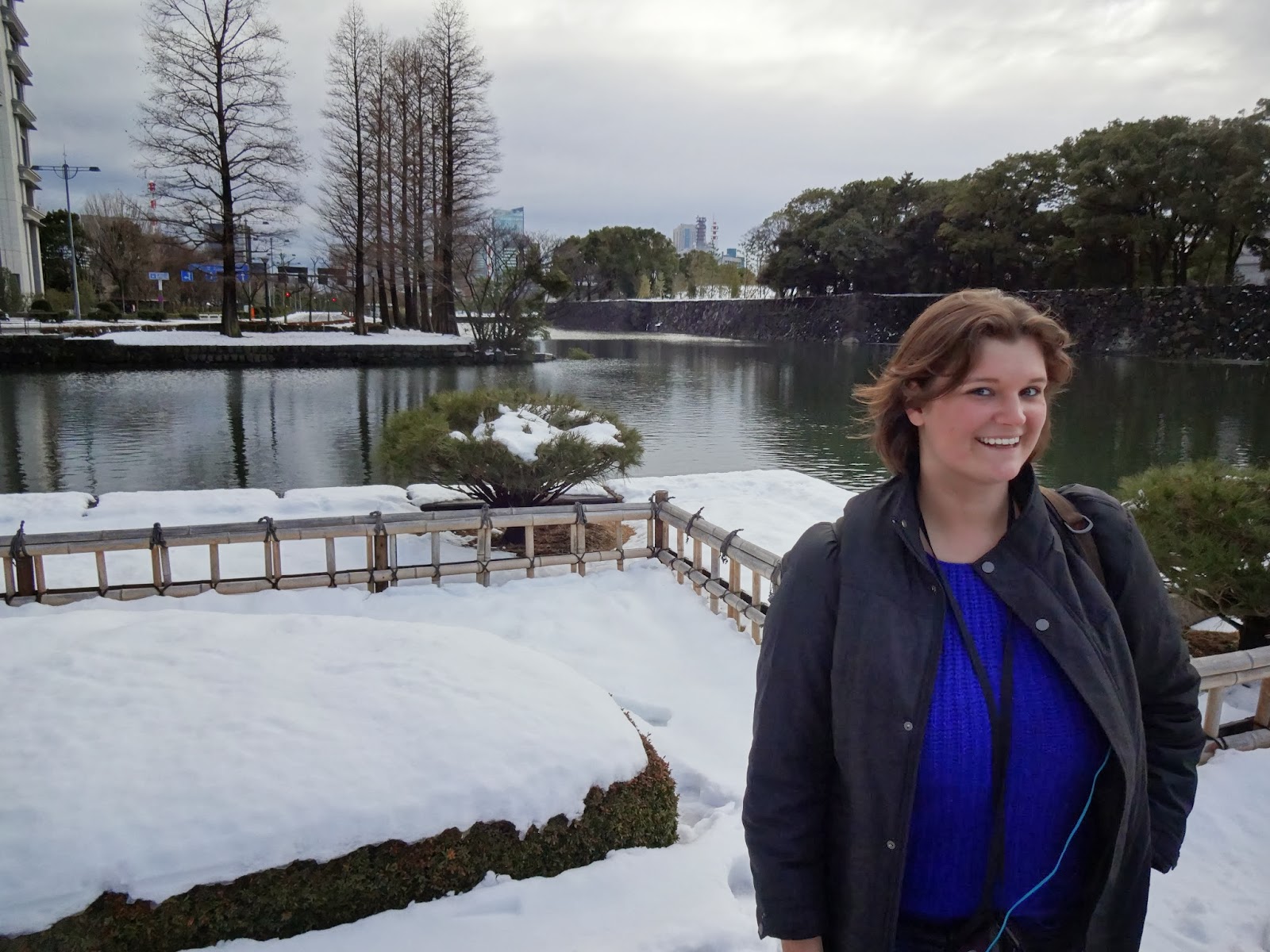
The moat surrounding the Imperial Palace.
As it was starting to reach early afternoon, I went back to Tokyo station and took the bullet train to Osaka where I went straight to the airport and spent the night on a row of chairs.  I never thought that I would be the type to sleep in an airport, but it was such a logical choice that I would gladly do it again.  This allowed me to arrive at the airport via train (all public transportation would have been closed at the needed hour, but my train pass let me travel for free), saved me money on a hostel, and ensured that I didn’t miss my 7am flight (it is no secret, I am not a morning person).   I was surprised to see quite a large number of people doing the same thing, and I was thankful for my arrival time because it gave me a prime location next to an outlet as I watched all of the other rows of chairs being converted into temporary beds.  I waited, and napped, and eventually boarded my plane and flew away.

And now, here I am again, back in Taiwan, happy to have had all of these experiences.  There is so much more that I could say about Japan, so many points I could make about cultural differences, but I am no real expert, and have my own continued research to do.   My last, and most important thought on the trip is this:

*The Japanese know what they are doing when it comes to toilets.  There is nothing better than realizing the seat is heated, not the cold ceramic you have come to expect.  Also, the water features of the high-tech toilets are appreciated once you understand how to use them.